
- All
- Product Name
- Product Keyword
- Product Model
- Product Summary
- Product Description
- Multi Field Search
Views: 0 Author: Site Editor Publish Time: 2026-07-23 Origin: Site


Deep burial infrastructure carries immense stakes for any municipal or industrial project. A catastrophic failure deep underground brings devastating excavation and remediation expenses. Engineers and project managers simply cannot afford guesswork under these conditions. You need absolute certainty before a single trench is backfilled.
Unlike rigid concrete pipes, flexible structured-wall systems behave very differently under massive soil loads. They rely entirely on soil-structure interaction to survive decades of crushing pressure. If you misunderstand this fundamental dynamic, structural collapse becomes a highly probable outcome. Flexible pipes do not fight the earth; they must work in harmony alongside it.
We will explore a rigorous technical evaluation framework for specifying these advanced thermoplastics. You will learn how to properly design, specify, and install HDPE Krah Pipe in deep applications. This guide equips procurement managers and site engineers to secure long-term structural integrity without over-engineering or overspending.
Traditional procurement teams often fixate heavily on inherent pipe stiffness. They evaluate flexible thermoplastics exactly like they evaluate concrete or cast iron. This mistake ignores how flexible conduits actually behave under crushing earth loads. We must shift our engineering mindset completely. Flexible systems require a holistic approach to structural integrity.
The load distribution model for flexible thermoplastics is fascinating. HDPE Krah Pipe is engineered to shed vertical soil loads horizontally into the sidefill. As the massive weight of deep earth pushes down, the pipe deflects slightly. This tiny vertical compression pushes the lateral pipe walls outward. This outward movement engages the passive resistance of the surrounding compacted soil. Ultimately, the dense soil envelope carries the majority of the structural burden, not the plastic itself.
Treating flexible conduits like rigid concrete poses severe dangers. Rigid pipes bear earth loads entirely alone. They crack and fracture when overloaded. Flexible systems survive extreme depths by sharing the stress. Evaluating these systems requires analyzing the entire pipe-soil composite structure. You cannot look at the pipe in a vacuum. You must account for soil quality, density, and compaction methodology to mitigate failure risks effectively.
Advanced thermoplastic technology stands apart because it allows for highly variable wall profiles. Manufacturers can dynamically adjust wall thickness and ribbing geometry during production. This customization achieves highly specific Ring Stiffness (SN) classes. You do not have to settle for rigid, off-the-shelf products. You can engineer the pipe precisely for your environment.
Decision criteria involve matching the profile design to exact project demands. You must consider burial depth, native soil density, and surface live loads. Over-specifying stiffness wastes raw material and inflates your budget. Under-specifying invites catastrophic structural failure. We recommend tuning the profile geometry precisely to the anticipated vertical load. This ensures optimal performance and superior material efficiency.
Engineers rely on standard mathematical formulas to predict long-term deflection. Spangler’s Modified Iowa Formula remains the industry benchmark. It calculates how much a flexible pipe will compress vertically over a fifty-year lifespan. Managing this diametric deflection is the ultimate goal of deep burial design.
The formula highlights a crucial synergy. The pipe’s inherent stiffness matters, but the Modulus of Soil Reaction ($E'$) matters significantly more. A high $E'$ value indicates dense, well-compacted soil. Strong soil severely limits deflection. If you specify an excellent HDPE Krah Pipe but place it in weak, uncompacted soil, deflection will easily exceed allowable limits. Soil provides the structural backbone.
Deep trenches routinely breach the local water table. High groundwater introduces severe external hydrostatic pressure. This pressure threatens the system with sudden buckling or upward flotation. Air-filled pipes naturally want to float in saturated soils. External water pressure can easily crush a thin-walled flexible pipe if engineers ignore it.
Evaluation requires ensuring the selected profile explicitly resists these specific hydraulic forces. You must rate the structural ribs for maximum external hydrostatic pressure at the absolute deepest trench point. Joint systems also face immense stress underwater. We heavily favor electro-fusion joints for these scenarios. They create a seamless, monolithic pipeline highly capable of withstanding intense groundwater pressure without leaking.
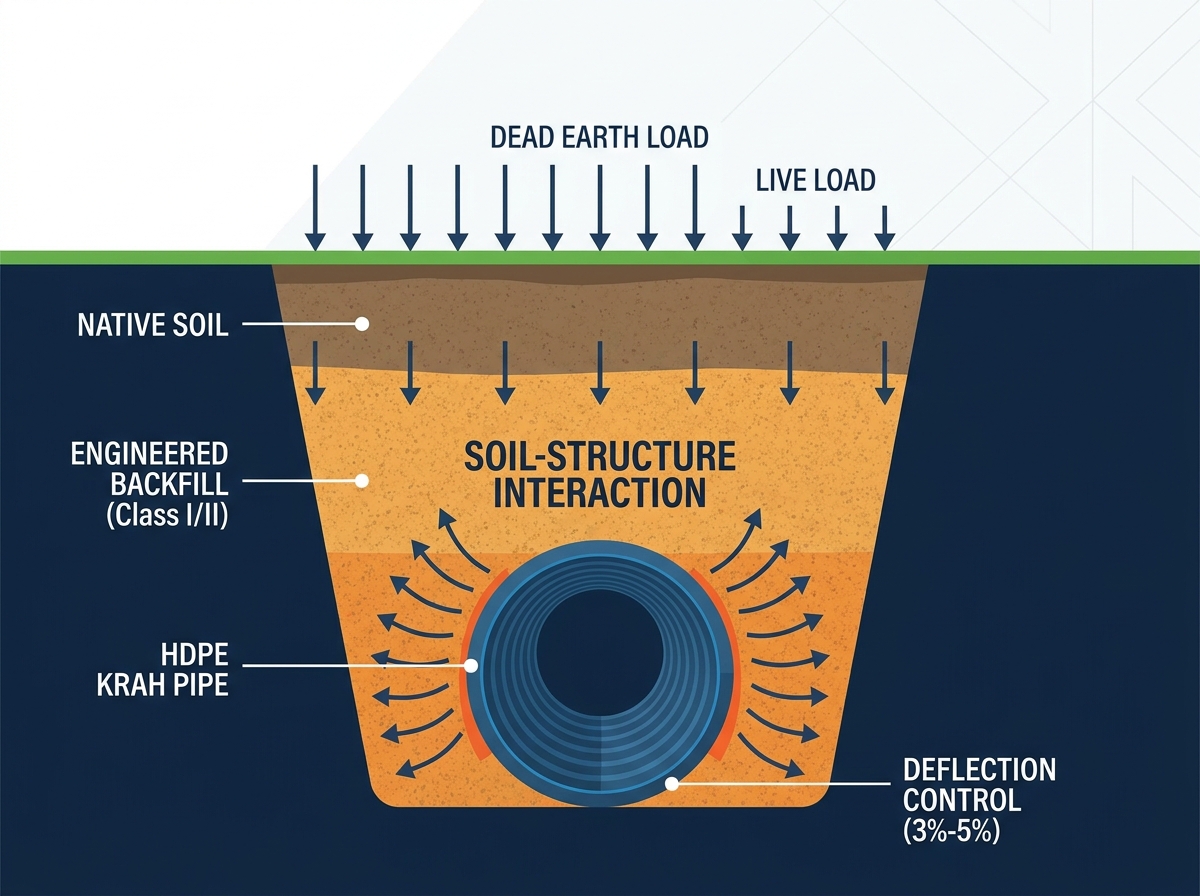
Trench dimensions directly dictate installation success. You must enforce strict minimum trench widths on the job site. The space between the pipe and the trench wall must comfortably accommodate mechanical compaction equipment. If workers cannot fit proper vibratory rammers alongside the pipe, compaction will fail. A narrow trench guarantees weak sidefill support and eventual pipe collapse.
Backfill quality is absolutely non-negotiable. Industry guidelines categorize soils into specific structural classes. Deep burial almost exclusively demands high-quality, easily compacted granular materials. You must use Class I crushed stone or Class II well-graded gravels. You cannot use clay or silty soils at extreme depths. They simply cannot provide the necessary passive resistance.
You must establish strict density baselines before construction begins. We require 90% to 95% Standard Proctor density for all sidefill materials. Poor compaction remains the leading cause of deflection failure globally. It is rarely a material manufacturing flaw. It is almost always a site compaction failure. Follow these critical compaction steps strictly:
Designing critical infrastructure requires strict adherence to technical specifications. We rely on established frameworks to guide our structural calculations. Standard ASTM F894 dictates specific requirements for profile wall high-density polyethylene. The AWWA M55 manual provides excellent, comprehensive guidance for polyethylene pipe design. Following these standards ensures structural viability and long-term legal compliance.
Engineers must apply standard safety factors carefully. Deep applications face distinct risks of wall buckling and compressive wall crushing. We typically apply a safety factor of 2.0 against hydrostatic buckling. Wall crushing safety factors often hover around 2.0 as well. These conservative buffers protect the system from unexpected vertical load spikes or minor installation errors.
Software modeling has revolutionized flexible pipe design. However, design software outputs remain only as reliable as the inputs. Geotechnical data drives the entire mathematical model. Site engineers must provide accurate soil weight, friction angles, and maximum groundwater levels. Bad field data always yields dangerous designs.
Comparison of Design Parameters
| Parameter Focus | Rigid Pipe (Concrete) | Flexible Pipe (HDPE) |
|---|---|---|
| Load Bearing Mechanism | Inherent material strength | Soil-structure interaction |
| Failure Mode | Cracking and fracture | Excessive deflection or buckling |
| Backfill Importance | Moderate | Extremely Critical |
| Design Metric | D-Load capacity | Diametric deflection limit (%) |
Not all manufacturers possess the necessary technical engineering rigor. You must demand specific technical capabilities from your chosen supplier. Look for comprehensive in-house finite element analysis (FEA). They must offer truly custom profile manufacturing capabilities. Always require project-specific structural calculations before signing any purchase order.
Quality control separates reliable suppliers from risky operations. You need to rigorously verify their batch testing protocols. Ask for historical data on ring stiffness tests. Check their electro-fusion weld strength documentation. Pay close attention to raw material purity standards. We strongly recommend specifying 100% virgin polyethylene. Regrind materials introduce unpredictable microscopic weaknesses under extreme earth loads.
Move carefully from preliminary feasibility to actual procurement. Do not guess on required wall thickness. Request a detailed, site-specific load calculation from the manufacturer's dedicated engineering team. Let their experts model your exact trench conditions. To get an accurate model, you should provide them with:
Designing HDPE Krah Pipe for deep burial represents a completely solved engineering challenge. You simply must respect the underlying laws of soil-structure interaction. By shifting focus away from raw pipe stiffness and toward the composite soil-pipe system, you guarantee long-term operational success.
Project success hinges directly on two distinct factors working together. You need a highly accurate, custom profile specification married to stringent trench installation protocols. One simply cannot survive without the other. Excellent engineering cannot overcome poor compaction, just as perfect compaction cannot save a structurally inadequate pipe profile.
We strongly advise municipal decision-makers to consult directly with geotechnical engineers early in the planning phase. Always request custom profile structural calculations from qualified manufacturers before finalizing your procurement specifications. Taking these proactive steps ensures your deep burial infrastructure performs flawlessly for generations.
A: Maximum depth is not a fixed number. It depends entirely on the custom profile design, the surrounding soil modulus, and local groundwater levels. By increasing wall thickness and optimizing rib geometry, engineers can safely design these systems for depths easily exceeding 10 to 15 meters. Excellent granular soil compaction is absolutely required to reach these extreme depths safely.
A: Live traffic loads dissipate significantly as burial depth increases. In deep burial scenarios, the dead weight of the earth becomes the primary structural concern. At depths beyond three meters, standard H-20 or HS-20 traffic loads exert almost zero influence on the pipe. Dead earth loads and hydrostatic pressure will drive your structural profile design instead.
A: Electro-fusion welding fuses the pipe segments together at a molecular level. This creates a continuous, completely leak-proof system. Welded joints entirely eliminate the risk of groundwater infiltration or exfiltration. They also prevent aggressive root intrusion over decades. Repairing failed mechanical joints at extreme depths is notoriously expensive, making electro-fusion the safest long-term choice.
A: Using excavated native soil carries massive structural risks. It is only acceptable if it strictly meets Class I or II granular material classifications. Native clays and silts cannot provide the rigid structural support flexible pipes require. You must be able to mechanically compact the soil to 90-95% Proctor density. If native soil fails this standard, you must import crushed stone.


